
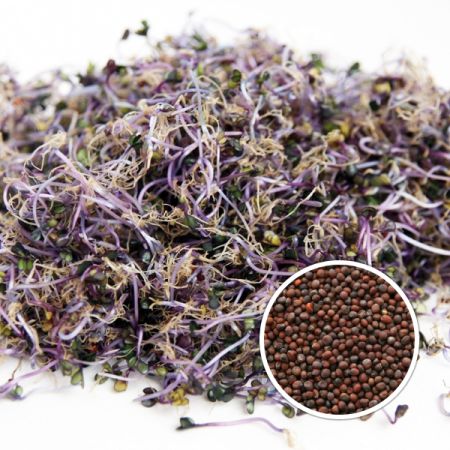
Cabbage Red for Sprouting & Microgreens Organic
Mild cabbage flavoured sprout. Stunning colour! More details below.
Organic Red Cabbage Seed for Sprouting
Red cabbage seeds are fresh and sweet like cabbage. Crunchy and ever so useful for salads and sandwiches. Like all brassicas they are easy to grow and very tasty. Red Cabbage sprouts have gorgeous red leaves with purple highlights and will add interest to any dish – very good with Ricotta cheese – as attractive to look at as it is good for your health.
Red Cabbage sprouts reinforce our defences and have digestive and tonic effects thanks to their high content of Calcium, Iron, Phosphorus, Iodine, Magnesium, Potassium, Zinc, and Sulphur.
Known as the latest superfood, the vitamins, minerals and compounds found in red cabbage microgreens serve to help boost your immune system, protect your eyesight, and stave off premature aging. Red cabbage is an elegant, two tone microgreen with a fresh cabbage crunch and subtle flavour. It is a great way to liven up any dish.
Microgreen Instructions:
Growing Time: 10 - 15 Days
Ideal Temperature: 20°C
Seeding Rate: 30 - 40 g per microgreen tray or 8 - 10g per small seed tray
Pre Soak: No
How To Grow:
- Fill a tray with compost. Firm into tray and moisten the soil.
- It is advisable to use a micro biologically tested compost such as Klasmann Peat Free Seed Compost to ensure there is no pathogens present.
- Sprinkle the seeds evenly over compost and press down gently and spray surface with water.
- Sprinkle the Broccoli seeds over compost and press down gently.
- Cover with a fine layer of compost.
- Cover seeds with another tray to give 4 full days of darkness with opening and airing once a day.
- Place somewhere with a good light source.
- Keep an eye on humidity levels- too much or not enough will lead to mold formation - but remember that it's best only from bottom watering this type of Microgreen.
- Best kept at a steady temperature of about 20oC
- You should see signs of germination after a couple of days.
- Should be ready in about 10-15 days.
Harvesting: When you are happy with your crop then cut your greens close to the bottom and gently rinse off any compost. If you feel they are getting too big they can all be harvested together and stored in a container in the fridge to keep fresh.
Sprouting Instructions:
- Rinse and soak the cabbage seeds in clean water for 5-6 hours.
- Yield: 1 tbsp of dry seed yields approximately 1 cup of sprouts
- Drain and rinse the seed and put them in your sprouting tray or jar.
- Rinse the seeds daily.
- Your seeds should be ready and have sprouted within five days.
- Brassicas have microscopic roots. They are called root hairs and are most visible just before rinsing when the sprouts are at their driest. When you rinse, the root hairs will collapse back against the main root - becoming invisible to you. These root hairs can look like mould - but they are not.
- Red Cabbage seed can also be sown as a microgreen.
Nutrition & Health Benefits:
- Contains vitamins A, B, C, E and K
- Red cabbage sprouts contain 40 times more vitamin E and six times more vitamin C, than the same mature red cabbage plant.
- Also rich in calcium, iron, magnesium, phosphorus, potassium, zinc, carotene, chlorophyll, antioxidants, trace elements.
- Red cabbage is also rich in the amino acid L-glutamine, which can help heal the soft tissue that lines your intestines. This is particularly valuable for people with such disorders as leaky gut, celiac disease, Crohn's disease, irritable bowel syndrome and ulcerative colitis.
- Red Cabbage sprouts have ‘Purple Power’ - anthocyanins and indoles are the source of the purple colour. They are extremely valuable for your health. One of their most important benefits is its ability to prevent cancer.
- During sprouting, minerals, such as calcium and magnesium, bind to protein, making them more bio-available. The content of vitamins and essential fatty acids also increase during the sprouting process.
- Protein: 20-5%
| SKU | MGRRCB |
|---|